


If you’ve needed a crown in the past, you probably remember the process. Two appointments, separated by a week or two. The first involved your dentist preparing the tooth, taking a physical impression — that slightly unpleasant tray of soft material you bite into and hold still — and fitting you with a temporary crown made of acrylic that you had to be careful with in the meantime. The second appointment, assuming the permanent crown came back from the laboratory looking right and fitting correctly, involved removing the temporary, cementing the permanent crown, checking the bite, and sending you home. Sometimes there was a third appointment if something needed adjustment. It worked. But it required multiple visits, involved a waiting period that could be inconvenient or anxious-making, and carried the risk that your temporary crown might come off or that the permanent one might need adjustments.
CEREC has changed this entirely.
What CEREC is and how it works
CEREC stands for Chairside Economical Restoration of Esthetic Ceramics, which is quite a mouthful — the technology itself is more elegantly straightforward. It’s a system that allows a dentist to digitally design and mill a custom ceramic restoration (crown, inlay, onlay, or veneer) in a single appointment.
The process begins with a digital scan. Rather than taking a physical impression with impression material, your dentist or dental nurse uses a small handheld wand — an intraoral scanner — to capture a three-dimensional digital image of your prepared tooth and the surrounding teeth. The scan takes a minute or two, is completely comfortable, and creates a precise 3D model on screen that the dentist can rotate, zoom into, and measure with accuracy that physical impressions struggle to match.
From this digital model, the dentist — using CEREC’s design software — draws the shape of your new crown. The software suggests a restoration shape based on your surrounding teeth and the anatomy of the prepared tooth, and the dentist refines this to ensure the bite is correct and the form is natural. The whole design process typically takes ten to fifteen minutes.
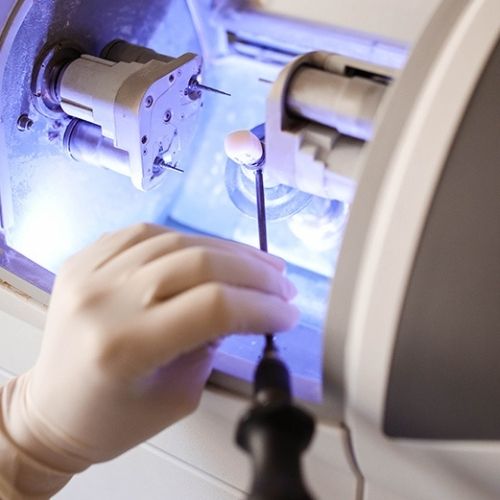
Once the design is finalised, it’s sent digitally to the CEREC milling unit — a compact machine that sits in or near the surgery. The milling unit carves your crown from a block of dental ceramic in approximately fifteen minutes. The block can be chosen to match the shade of your natural teeth, and in some cases the dentist or dental nurse may make small adjustments to characterise the colour and surface texture before the crown is polished and glazed.
The crown is then fitted, the bite is checked and adjusted if needed, and you leave with a finished, permanent ceramic restoration — all in the same appointment. No temporary crown. No second visit. No waiting to find out if the laboratory’s shade match looks right on your tooth.
Why ceramic matters
CEREC restorations are made from lithium disilicate or zirconia ceramic — high-strength dental materials that mimic the optical properties of natural tooth enamel. They’re metal-free, which matters both aesthetically (no dark grey margin at the gumline as you age) and clinically (no concerns about metal sensitivity). The materials are highly biocompatible and have an excellent long-term track record in clinical research.
The ceramic used in CEREC restorations is the same class of material used by dental laboratories for high-end ceramic restorations. The difference is that instead of a ceramist hand-building the crown layer by layer, the milling process carves it from a single block.
For single-tooth restorations, this produces results that are clinically comparable and aesthetically very satisfying. For complex multi-tooth restorations or cases requiring highly customised ceramist characterisation, the in-house Smile Lab may still be involved — but for the large majority of crown cases, CEREC’s milled restorations are an excellent and efficient solution.
Digital scanning: the end of goopy impressions
One of the patient experience improvements that people appreciate most is the replacement of traditional impressions with digital scanning. Physical impressions trigger a gag reflex in some patients, are uncomfortable to hold, and occasionally distort — particularly if you move, breathe at the wrong moment, or have anatomy that makes the tray difficult to seat. A distorted impression means a crown that doesn’t fit as precisely as it should, which leads to either a remake or cement masking a marginal discrepancy.
Digital intraoral scanners capture the tooth surfaces as a point cloud of thousands of measurements, which the software assembles into a dimensionally accurate 3D model. The scanner is a small device that moves around your mouth — you don’t have to bite, hold your breath, or stay perfectly still for a set amount of time. The operator can see on-screen in real time whether any areas of the scan need to be supplemented, and the final model is immediately available for checking accuracy before any design work begins.
The digital model is also a permanent record. It can be stored, retrieved, and compared with future scans — useful for tracking changes in the bite or wear over time.
The broader technology suite at Core Dental
CEREC sits within a broader commitment to digital technology across Core Dental locations. Digital OPG (orthopantomogram) imaging provides a full-mouth panoramic x-ray with a fraction of the radiation of older analogue systems, and the image is immediately available on screen for review with the patient. 3D CBCT (cone beam computed tomography) imaging provides three-dimensional views of the jaw, teeth, sinuses, and bone structure — critical for implant planning, assessment of impacted teeth, and diagnosis of conditions that two-dimensional x-rays can miss. Intraoral scanners are used across multiple Core Dental locations not only for CEREC crown design but for orthodontic records, study models, and general diagnostic purposes.
The combination of these technologies means that a patient attending Core Dental today receives diagnostic imaging and restorative care at a standard that simply wasn’t possible in general dental practice a generation ago. What once required a hospital referral for CBCT imaging, or a two-week wait for a laboratory crown, can now happen in a single visit at a suburban dental practice.
What same-day means in practice
If you’re considering a crown and wondering whether to pursue the same-day CEREC option, the practical considerations are straightforward. You need to block out a longer appointment — typically around ninety minutes to two hours — to allow time for preparation, scanning, design, milling, and fitting. The time you spend in the chair is more than a typical single appointment but less than two appointments combined. And you leave with a finished, permanent crown instead of a temporary.
For patients with busy schedules, anxiety about extended dental treatment, or upcoming events (a wedding, a holiday, a work conference) that make a gap between appointments inconvenient, same-day CEREC is often exactly what the situation calls for. Ask your Core Dental dentist whether your case is suitable — the large majority of single-crown cases are.
Technology in dentistry has come a long way. At Core Dental, we’ve made sure the technology is there when it matters.