


The dental crown that used to take two weeks and two appointments now takes about an hour – here’s the technology behind it.
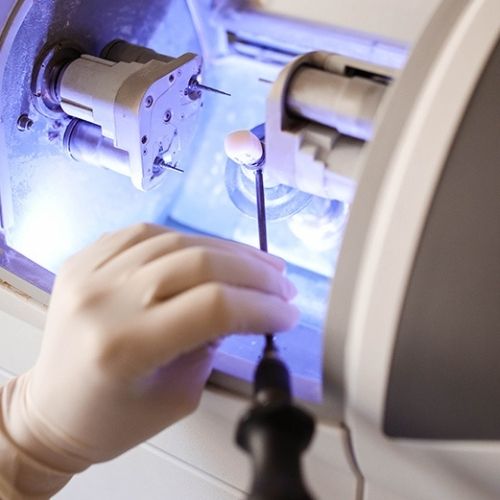
CEREC Technology
Picture the traditional dental crown process. You visit your dentist, the tooth is prepared, an impression is taken using putty trays that make you gag, and a temporary crown is fitted. You go home with instructions not to eat anything sticky, not to chew on that side, and to come back in two weeks. During those two weeks, the temporary crown pops off at least once (usually while eating something you were specifically told to avoid). When you finally return, the permanent crown is tried in, adjusted, and cemented. Two appointments, two rounds of anaesthesia, two disruptions to your schedule, and a fortnight of managing a fragile temporary.
Now picture this: you walk into Core Dental in the morning, and by lunch, you walk out with a permanent, precision-milled ceramic crown bonded to your tooth. No temporary. No second appointment. No impression trays. No waiting. That’s CEREC – and it’s available at every Core Dental location across Melbourne.
CEREC same-day crowns aren’t new. The technology has been in development since the 1980s and in clinical use for over two decades. But the current generation – CEREC Primescan with Primemill – represents a quantum leap in accuracy, speed, and material quality that has genuinely changed what’s possible in a single dental visit.
What Is CEREC, Exactly?
CEREC stands for Chairside Economical Restoration of Esthetic Ceramics. It’s a CAD/CAM (computer-aided design/computer-aided manufacturing) system developed by Dentsply Sirona that allows dentists to design and mill ceramic restorations – crowns, onlays, inlays, and veneers – right in the practice, while you wait.
The system has three integrated components:
1. Digital Scanner (Primescan)
Instead of biting into impression trays filled with silicone or alginate, your dentist uses a small handheld scanner to capture a three-dimensional digital model of your teeth. The scanner takes thousands of images per second, building an extraordinarily detailed 3D map of the prepared tooth, the surrounding teeth, and the opposing arch. This digital impression is more accurate than traditional physical impressions and far more comfortable for the patient.
2. Design Software
Using the digital model, your dentist designs the crown on screen. The software proposes a restoration shape based on the anatomy of the surrounding teeth and the opposing bite, which the dentist then refines – adjusting contacts, contours, occlusion, and emergence profile. This is where clinical judgment meets technology: the software provides the starting point, but the dentist’s understanding of function, aesthetics, and your specific bite determines the final design.
3. Milling Unit (Primemill)
The approved design is sent wirelessly to the milling unit, which carves the crown from a solid block of ceramic using diamond-coated burs. Modern milling units can produce a crown in as little as four to five minutes. The milled crown is then stained, glazed, and fired in a small furnace to achieve the final colour, translucency, and surface finish before being bonded to your tooth.
The Clinical Process: What a Same-Day Crown Visit Looks Like
Understanding the step-by-step process helps demystify what’s happening and explains why the results are so consistent.
Step 1: Assessment and Preparation
Your dentist examines the tooth and determines whether a crown is appropriate (versus an onlay, inlay, or filling). The tooth is prepared under local anaesthesia – decayed or weakened tooth structure is removed, and the remaining tooth is shaped to receive the crown. This preparation step is identical whether you’re having a CEREC crown or a traditional crown. It’s the clinical foundation of a good result, and it requires the same skill and attention regardless of the fabrication method.
Step 2: Digital Scanning
With the tooth prepared, your dentist scans the area with the Primescan. This takes two to three minutes. You’ll see your teeth appear on screen in real time – a detailed, colour 3D model that the dentist inspects for completeness. If any area wasn’t captured clearly, a quick re-scan fills the gap. The scan also captures your bite (how the upper and lower teeth meet), which is critical for designing a crown that functions correctly.
Step 3: Design
This is where CEREC really shines. Your dentist designs the crown on a large monitor, and many choose to walk patients through the process. You can see the proposed crown taking shape, understand why certain contours matter, and even provide input on aspects like how bulky or slim you’d prefer the tooth to feel. The design phase typically takes 10 to 15 minutes, during which the software calculates precise clearances with opposing teeth, appropriate contact points with adjacent teeth, and anatomically correct cusp placement.
Step 4: Milling
The design is sent to the Primemill, and the crown is carved from a block of ceramic selected to match your natural tooth colour. Modern ceramic blocks come in a range of shades and translucencies, and multi-layered blocks (like CEREC Tessera or Vita Enamic) mimic the gradual transition from opaque dentine to translucent enamel that characterises natural teeth. Milling takes approximately four to five minutes.
Step 5: Characterisation and Firing
The milled crown is customised with surface stains and glaze to match the colour, texture, and lustre of your natural teeth. It’s then fired in a compact furnace (typically a CEREC SpeedFire) for around 10 to 15 minutes. This firing step crystalises the ceramic, achieving its final strength and optical properties.
Step 6: Bonding
The finished crown is tried in your mouth, checked for fit, bite, contacts, and aesthetics, and then bonded to the prepared tooth using adhesive resin cement. The bonding process itself creates a strong, durable connection between the ceramic and the tooth structure – effectively integrating the two into a single unit.
Total chair time: typically 60 to 90 minutes from start to finish.
Material Quality: Are CEREC Crowns as Good as Lab-Made Crowns?
This is the question every informed patient asks, and it deserves an honest answer.
The ceramics used in CEREC restorations are the same high-quality materials used by dental laboratories. Lithium disilicate (e.max), zirconia-reinforced lithium silicate (Celtra Duo), and hybrid ceramics (Vita Enamic) are all available in CEREC block form. These materials have been extensively researched, with clinical studies showing longevity comparable to traditionally fabricated crowns.
A 2023 systematic review published in the Journal of Prosthetic Dentistry found that CEREC lithium disilicate crowns had a survival rate exceeding 95 per cent at 10 years – matching the performance of laboratory-fabricated crowns of the same material. The accuracy of fit, assessed by marginal gap measurements, has been shown in multiple studies to be equivalent or superior to traditional impression-based workflows.
Where CEREC and laboratory crowns differ is in the range of complexity they can handle. For a single crown on a premolar or molar, CEREC produces an outstanding result with efficiency that a laboratory workflow simply can’t match. For highly complex aesthetic work – matching multiple veneers across the front teeth, managing challenging shade situations, or fabricating long-span bridges – a dedicated laboratory with a master ceramist hand-layering porcelain may offer advantages in customisation.
This is where Core Dental’s model is particularly powerful. Our in-house Smile Lab provides the best of both worlds. For complex cases that benefit from hand-crafted laboratory artistry, our ceramists are literally in the building – your dentist can walk into the lab, discuss shade and characterisation in person, and even bring the ceramist chairside to observe the tooth in natural light. For routine crown work where efficiency and accuracy are paramount, CEREC delivers a same-day result that’s clinically excellent.
When Is a Same-Day Crown Appropriate?
CEREC crowns are suitable for the majority of crown situations in everyday practice:
- Teeth weakened by large fillings that are at risk of fracture
- Cracked or fractured teeth where sufficient structure remains for a crown
- Teeth that have had root canal treatment and need protection
- Teeth with significant decay once the decay has been removed and the remaining structure assessed
- Replacement of old, failing crowns that have deteriorated, become discoloured, or developed recurrent decay at the margins
- Cosmetic improvement of misshapen, severely discoloured, or worn teeth
There are some situations where a CEREC crown may not be the first choice:
- Full-mouth rehabilitation involving many teeth – these complex cases benefit from comprehensive laboratory planning with mounted study models and diagnostic wax-ups
- Anterior teeth requiring exacting aesthetic matching in a challenging shade environment – here, the hand-layering capabilities of a skilled ceramist may be preferred
- Very large restorations or unusual anatomy that pushes the boundaries of mill-able geometry
Your Core Dental dentist will assess your specific situation and recommend the approach that will deliver the best clinical and aesthetic outcome.
Benefits of Same-Day Crowns
For patients, the advantages of CEREC are substantial:
One appointment instead of two
No need to take another half-day off work or arrange childcare twice. Everything happens in a single visit.
No temporary crown
Temporary crowns are exactly that – temporary. They can fracture, come loose, leak, or simply feel uncomfortable. Eliminating them removes an entire category of inconvenience and potential complication.
No impression trays
If you’ve ever gagged through traditional impressions, you’ll appreciate digital scanning. It’s faster, cleaner, and dramatically more comfortable.
Immediate function
Because you’re leaving with the permanent crown, you can eat normally (once the anaesthetic wears off) without worrying about damaging a temporary.
Precision
Digital workflows eliminate several potential sources of error: impression distortion, stone model expansion, shipping to the laboratory, and analogue fabrication steps. Each eliminated variable contributes to greater consistency.
Common Questions About CEREC Crowns
Yes. From a health fund perspective, a CEREC crown is simply a dental crown. Your level of cover depends on your extras policy and annual limits, not on how the crown was manufactured. We process health fund claims on the spot at Core Dental through HICAPS.
Current evidence suggests yes. With good oral hygiene, regular dental reviews, and sensible care (not using your teeth to open bottles or chew ice), a CEREC ceramic crown can last 10 to 15 years or longer – comparable to any high-quality ceramic crown.
The preparation is performed under local anaesthesia, so you shouldn’t feel pain during treatment. You may experience some sensitivity once the anaesthetic wears off, particularly if the tooth was heavily restored or had a deep cavity, but this typically settles within a few days.
Yes. Every Core Dental location is equipped with CEREC technology, meaning patients across Melbourne can access same-day ceramic crowns without needing to travel to a specialist centre.
The Core Dental Difference
Technology is only as valuable as the clinicians using it.
Every Core Dental practice combines CEREC technology with experienced dentists, digital scanning, modern adhesive techniques, and access to the broader Smile Solutions network. If a case would genuinely benefit from laboratory fabrication rather than chairside milling, we have an in-house laboratory and ceramists available. If a case is suitable for same-day treatment, we can often complete it while you wait.
That flexibility – choosing the right solution for the right patient rather than forcing every case into the same workflow – is one of the advantages of being part of a larger integrated dental group.
Book a Same-Day Crown Consultation
If you’ve broken a tooth, have a large failing filling, or have been told you need a crown, ask whether a same-day CEREC crown is appropriate for your situation.
Our dentists at Core Dental can assess your tooth, explain your options, and in many cases complete your permanent ceramic crown in a single visit.