


Not long ago, dentistry relied heavily on physical impressions — that gooey, slightly uncomfortable putty that gets pressed into your mouth and held there for what feels like an eternity while you try not to gag. X-rays were taken on small individual films placed awkwardly inside your cheek. And treatment planning often involved a fair amount of educated guesswork about what was happening beneath the surface.
Things have changed significantly.
Modern digital dentistry tools give clinicians a far clearer, more accurate picture of your oral health — and they make the experience considerably more comfortable for patients. At Core Dental, we’ve invested in the full suite of these technologies across our locations, and we use them as a standard part of how we work.
Here’s what they are, what they do, and why it matters to you.
Digital OPG: the panoramic view of your mouth
An OPG (orthopantomogram, or panoramic X-ray) is a single image that captures your entire upper and lower jaw — all your teeth, your jawbone, your sinuses, and the joints where your jaw meets your skull — in one sweep.
The X-ray unit rotates around your head, and you simply stand still for a few seconds.
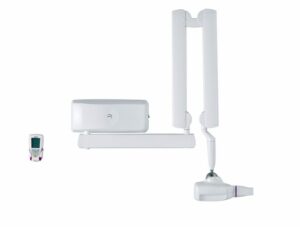
In the past, this kind of X-ray required significant chemical processing and produced film images that had to be held up to a light box for reading. Digital OPG produces an image instantly, on-screen, in much higher resolution. Your dentist can zoom in, adjust contrast, and see details that would have been difficult or impossible on traditional film.
This is often the starting point for new patients, or for patients who haven’t had a full assessment recently. A digital OPG gives an immediate overview of everything — including teeth that haven’t erupted yet, wisdom teeth positions, bone density around the teeth, and early signs of pathology that wouldn’t be visible any other way.
It’s an efficient, low-radiation way to understand the complete picture before making any treatment recommendations.
3D CBCT imaging: when you need to see in three dimensions
Cone Beam CT (CBCT) scanning is a step beyond the panoramic view. Instead of a flat two-dimensional image, CBCT produces a three-dimensional model of your jaws, teeth, and surrounding anatomy that can be rotated and sliced in any direction on-screen.
This level of detail is transformative for certain types of treatment planning. When placing dental implants, for instance, the treating dentist needs to know exactly where the nerve runs in your jaw, the precise dimensions of available bone, and the angle that gives the best outcome. A 2D X-ray provides an approximation; CBCT provides precision.
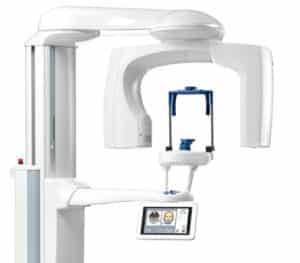
CBCT is also invaluable for assessing complex root canal cases (where the anatomy of the tooth’s root system may be unusual), for evaluating impacted wisdom teeth before removal, for orthodontic planning in complex cases, and for diagnosing jaw joint problems.
It takes seconds to capture and exposes patients to significantly less radiation than a medical CT scan.
At Core Dental, CBCT is available in-house, which means this information is accessible immediately — no referrals to external radiology centres, no waiting days for results.
Intraoral scanning: no more messy impressions
If you’ve ever had a crown, a veneer, orthodontic aligners, or a dental device made, you’ll remember the impression. The tray of material pressed into your mouth, the effort not to breathe through your nose, the minutes of waiting while it set. It worked — but it wasn’t pleasant.
An intraoral scanner replaces that process entirely. The scanner is a small wand — about the size of an electric toothbrush — that the dentist passes slowly around your mouth. It captures thousands of images per second and stitches them together in real time to produce a precise digital model of your teeth and gums. On a screen next to you, you can actually watch your 3D dental model being built as the scanning happens.
This model is then used directly in treatment planning and in the fabrication of dental restorations, aligners, or appliances. Because it’s digital, it can be sent electronically to our in-house Smile Lab — or to specialist labs and aligner manufacturers — without physical impressions needing to be transported or stored. Accuracy is typically better than traditional impressions, which can distort slightly during the setting process.
The experience for patients is genuinely comfortable. No gagging, no taste, no waiting. For children in particular, removing the impression experience makes a significant difference to how dental visits feel.
CEREC same-day crowns: from scan to fitted crown in a single visit
CEREC (Chairside Economical Restoration of Esthetic Ceramics) is the technology that brings intraoral scanning, digital design, and in-chair milling together to produce ceramic dental restorations on the same day — in a single appointment.
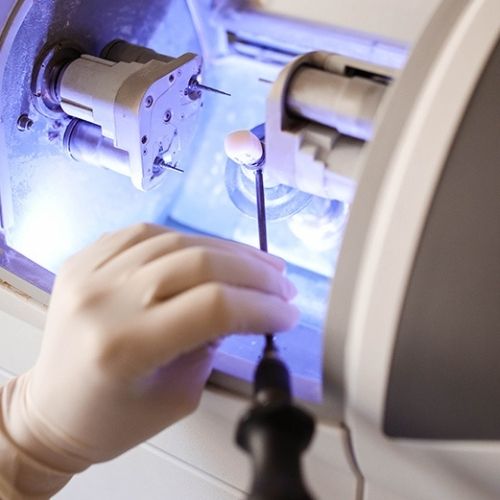
Here’s what a traditional crown involved: an impression, a temporary crown fitted while a lab made the permanent one over two weeks, and then a second appointment to remove the temporary and fit the final crown. Two visits, a two-week gap, and the inherent imprecision of temporary crowns.
With CEREC, the process is: scan, design, mill, fit. The digital scan is taken, the software designs the crown to match your bite and surrounding teeth, a ceramic block is milled to the precise specifications in the in-office unit, and the finished crown is fitted and cemented in the same appointment. The whole process typically takes around an hour and a half to two hours.
The ceramic used in CEREC restorations is high-strength and tooth-coloured, matching the appearance of natural teeth. Patients who need a crown often find the single-visit process dramatically more convenient — no temporary crown to manage, no second appointment, and the knowledge that everything was designed and fitted by the same team with full continuity of care.
Why this all connects
The reason these technologies work so well together is that they’re all part of a digital workflow. The information captured by scanning and imaging feeds directly into treatment planning, fabrication, and record-keeping without the accuracy losses that physical impressions and film X-rays introduce. For patients, this means more accurate diagnoses, better-fitting restorations, more predictable outcomes, and considerably more comfortable appointments.
Digital dentistry isn’t a luxury add-on. Done properly, it makes dentistry more accurate, more comfortable, and more efficient for everyone involved. It’s simply how modern dental care should be delivered.
Have questions about a specific procedure or what to expect?
We’re always happy to walk patients through what any appointment will involve. If you’re curious about what imaging or scanning is appropriate for your situation, just ask at your next visit — or call your nearest Core Dental location to speak with our team.